Who is laughing? And who is doing the killing? (Essay with music)

On the 3rd of May 2015 the so called ‘American Freedom Defence Initiative’ organised a competition offering $10 000 for the best caricature of Prophet Mohammed. The event took place in the Dallas suburb of Garland, Texas, United States, in a building belonging to a private school, not in New York where the main organiser lives, but in Garland, which is described as the most ethnically mixed town in the country.

Two hundred people turned up to compete and the organiser privately bought in 40 police men in addition to the other security staff provided by the school. We have been informed that two young men turned up with guns and one of them has lightly injured one of the security guards. The two gun-men were killed in no time. Their dead bodies were left on the street for hours while experts were searching for potential bombs. The people participating in the event were moved to another location, and it seems, the competition was completed, as the winner’s name has been published.

The intention to provoke tension and to create violent conflicts between people who could happily live next to each other has many old and new forms. Not for the first time in history, ‘divide and rule’ dominates international and domestic politics in many powerful countries, inc. the USA, UK, Russia, India. It is tragic that many ‘ordinary’ people are willing to be polarised, deciding that another group of ‘ordinary’ people are their enemy. The political and economical elite greatly benefits from these divisions and hatred. They covertly or openly encourage the divisions (while in the West also paying lip-service to ‘equal opportunities’, ‘universal human rights’ etc). They don’t like to dirty their own soft hands with blood, but they encourage, pay or order others to do the dirty work.

Conscription – in times of potential wars  – is a demand on a mass scale to attack and kill those whom your political leaders perceive as their enemy, and to sacrifice your life. Where there is no conscription, manipulation needs to achieve that a large number of people should ‘want’ to kill and die for the interest of their political and economic elite, and their families, friends, schools, Churches are expected to stand behind ‘our heroes’. It is useful if the the fighters personally believe that they are killing for noble causes. On addition serious efforts are made to create a general public perception and consensus that the paid armies are fighting and killing for noble causes.

The people who ‘voluntarily’ join the killing fields (any type of killing fields) are normally poor. They are often in desperate need of money, a job, or a purpose in life, or they may wish to achieve (strangely conceived) ‘self-respect’. They may even have something to revenge for: either in their communal (or ethnic) history, or perhaps the story of their family or personal traumas provide extra motivation. They may be full of frustration and anger created by their own collective or individual life-histories, ready and willing to turn these feelings against any ‘enemy’ named by others, by powerful manipulators. I imagine, all over the world many people join the police, the security firms, the armies or any type of religious military crusade (including the much talked about ‘jihad’) because in these organisations they will be respected and rewarded if they act violently. Many fighting people who believe in this or that religion may be doing the killing in the name of their God, while others refer to ‘patriotism’ – despite the fact that most of the wars nowadays are being fought far away from the soldiers’s and the fighters’ homeland. If I was a soldier I would not like to know that I am simply serving the economical and  political purposes of the economical and political elite. If I was religious, perhaps I would like to think I am fighting for my religion. Or for my country. Or both. Sounds heroic and noble.

Muslim and Christian people have not always fought each other. For the rest of the article I will refer to the Western and US powers as Christian, despite the fact that a large percentage of the population have other religions, and many are atheists. The UK and the US governments still claim the Christian religion as their right, and recently in their so called ‘War on terror’ they have increasingly used religious – and colonial – language. There are many places in the world where Muslim and Christian people (and others following Jewish, Hindu, Buddhist religions and life-styles) were living in peace right next to each other for centuries.

The only time Christians and Muslims are encouraged to hate each other are times when a crusade was/is initiated by political leaders, who often managed to get their religious leaders to work for them too. This happened whenever the rulers of powerful Christian or Muslim countries wanted to dominate the same piece of land, wanted to extend their empires in the same direction. However when they turned in other directions, they managed to ignore each other and they stopped concerning themselves about the rights and wrongs of Christianity or Islam. For example they were not focusing on hating each other when Spain, Portugal and England decided to expend to South and North America. Instead of thinking about Islam they were busy hating the population they found in the Americans whom they named ‘Indians’ and whom they wanted to ‘civilize’ (make them useful for their purposes). Similarly when  the Islamic empires decided to extend towards India, then it must have become more important for them to convert Buddhists and Hindus into Muslims, and they have achieved this to some degree.

Therefore the crash of Islam and Christianity depends on a simple question: do the political leaders of powerful Islamic and Christian countries are fighting for the control of the same part of the world?

The current answer is: YES. They do want to control the same part of the world. The part which is known in the West as the ‘Middle East’.
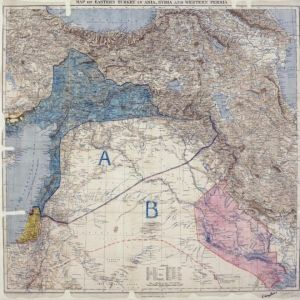

The above on the left is the original secret Sykes-Picot map of 1916: “A” would go to France, “B” to Britain. And the map on the tight shows the same in a clearer form. The map below shows the extent of military power physically present in the Middle East, now.

US bases in the Middle East

It has a long history, but where are we now? In Texas in May 2015 a few (perhaps) naive and potentially dangerous ‘ordinary’ people decide to organise a ‘caricature competition’ to help this nasty fight. Some of the participants may believe it is really about ‘freedom of speech’, while others may have turned up desperate for the $10 000 top price, but it is clear that this event was organised to provoke. They invited a Dutch politician known about his racist views as the ‘Guest of Honour’.  He is not naive and not ‘ordinary’. He is part of the power elite, his party is the 4th most popular in the Netherlands. Then two (perhaps) naive and dangerous ‘ordinary’ young men jump like puppets, rushing there with the intention to kill some of the participants. In the name of  their ‘God’. At least this is what we were told by the media – they did not speak. Then a few (perhaps) naive and potentially dangerous ‘ordinary’ people, who are paid security guards or private police, immediately kill those who seemed to want to kill the competitors. Who benefits? Who is laughing?

Pamela Geller, the organiser of this event must have expected an attack as she herself paid 40 private police officers to guard the building, it costs her $10 000 according to The Guardian. She said she paid because this is “the high cost of freedom”.

The Guest of Honour “Wilders has campaigned to stop what he views as the “Islamisation of the Netherlands”. He compares the Quran with Mein Kampf and has campaigned to have the book banned in the Netherlands. He advocates ending immigration from Muslim countries, and supports banning the construction of new mosques.” (Wikipedia)

And who is Pamela Geller, the American woman who organised this event? According to The Guardian she is the co-founder of the ‘American Freedom Defence Initiative’ which is behind the contest to award $10,000 for the best cartoon depiction of Mohammed. She is a New Yorker who writes a blog called ‘Atlas Shrugs’ that campaigns to stop the “Islamisation” of America. Pamela Geller used to be a housewife not interested in politics until 9.11 when she turned. After the shooting yesterday she used her blog ‘Atlas Shrugs’ to declare: “This is a war. This is war on free speech. What are we going to do? Are we going to surrender to these monsters?”

BBC World Service broadcasted a short interview with the Mayor of Garland. He explained that the event has nothing to do with the town. They did not ask his permission, in fact it was authorised by a private Education Authority which provided the venue. He made it clear he was not happy about this competition. He said his city is the most ethnically diverse city in the States, and the neighbourhood which is the most ethnically diverse neighbourhood. So why they picked this one?

In January 2015 a large conference was organised in Garland by the local Muslim Community, to plan how they should stand up AGAINST Islamic fundamentalism. While the conference was taking place thousands of white people were protesting against them. One of the placards said: “Muslims, go home! And take Obama with you!” Here it is:


Garland, US Anti-Muslim Demo Jan 2015

MY CONTACT DETAILS

The best way to contact me publicly is by writing a comment under a post. If you would like to contact me privately, you can write to piroskamarkus.wordpress@gmail.com

Walking upstairs I was thinking

When I was coming home yesterday walking up the stairs, I was thinking, someone famous once said: “every society could be judged on the basis of how it treats women”. I suddenly thought: “Every society can be judged, from how it treats ‘mad’ people.”  Then my thinking jumped and I thought: “how it creates madness”.

And my (nearly) final conclusion was: “every society can be judged, from how it creates and treats it’s mad”.

Then I thought: feminists have rightly criticized the word ‘treat’ – and the idea, which is implied, that women are not part of the society. Because the original statement implies, that the society is male and women are external to it, some kind of ‘objects’ – to which the male-society relates: men ‘treat’ women.

There is already so much wrong expressed in these words. I always hated when men said “I treat my wife/girlfriend really well”. I usually have a feeling that they are talking about a dog, who should feel privileged. – All of these thoughts and ideas swam, or rather, rocketed through my head while I was making the steps upwards.

The next thought was: ‘judged’ is the wrong expression. I asked, who am I to judge? Or who are supposed to be the judges according to the original statement? Are they not part of the society? What makes them either outsiders or superior beings, above everyone else, and independent?

I concluded quickly: instead of ‘judged’ I could say: “Every society has it’s own typical way of ‘treating’ and creating it’s women and it’s mad.” Societies create role models for women and they use various methods to force the individual women to conform to these female images. Societies also create their own concepts of ‘normality’ and ‘madness’, and they offer typical mad-roles.

Shop-window women

I started to laugh. Because at this point, I realised, it was not only self-evident, it was banal!Of course it has. It also has it’s own way of creating male roles, children-roles, cities and hierarchies, customs and memories. Nothing seemed more obvious, I thought, and felt ridiculous for thinking about the whole subject. I arrived in front of my flat, opened the door, said a loud hello to my kids, and shut my brain. 

Piroska Markus

(I wrote this piece sometimes in the 1990’s when I had three small children and I was working as a mental health social worker in Central London. We were living on the 2nd floor of a large Council building so all these thoughts went through my head during the 2 minute it took to walk up from the ground floor to our flat.)

Madness and it’s enemies. Part One

I am an ‘expert’ on madness. At least I would like to be.

Not because I used to be a mental health social worker for many years.

Not because I have a few useless certificates in three different types of counselling.

I believe I am an ‘expert’ because I have been struggling against madness in myself since I became an adult.

Perhaps I can get extra qualification to call myself an expert as a relative of people with mental health problems, who occasionally ended up in psychiatric hospitals. Luckily, I have never entered psychiatric hospitals as a patient, but I often entered psychiatric hospitals as a professional. And it is part of the game there, that if you are a mental health professional, you have to pretend to be normal. You have to pretend you have never had any overwhelming mental or emotional issues at all, you are in total control of yourself, you are a balanced and well functional person, in contrast to “them” – the patients, who are your opposites. As a consequence, as a mental health professional you supposed to hide and suppress all those parts of you, which may remind you (and remind your colleagues) the undesired qualities of “them”, the patients.

With this kind of background, me writing openly about this subject has similar significance, as a gay person ‘coming out of the closet’.

My father and my sister normally had a ‘normal’ life, but they both had a few breakdowns. In fact my father had a successful carrier as a Sociologist in Hungary. My sister managed to finish a 5 years university  course and she had three children. Unfortunately both my father and my sister were given the diagnosis of ‘manic-depression’, or ‘bipolar’ as it is called today. They both had a few admissions to psychiatric hospitals. Although it is fashionable to call family members ‘carers’, I would never use this term about myself in relation to my father and sister. I find the term patronising and misleading.

It is well known that families can easily drive one (or more) of their members mad. Everybody knows it, and even some of the official experts had admitted it long time ago. Occasionally they deny it, and I believe the term ‘carer’ is a (perhaps unconscious) attempt to deny the tensions, the harm which can be caused by a family to the person who goes mad: before their breakdown, during the breakdown, and afterwards. – I was never really the ‘carer’ of my father or my sister, especially not when they gone high or manic, I don’t think anyone has a chance to be a ‘carer’ for an extremely high person: they slip out of your hands. They are too high to be ‘cared for’, unless they are sectioned to a hospital and the ‘care’ they don’t want is forced on them. And then, they might not perceive such a treatment as ‘care’, more like imprisonment.

I witnessed them going high, becoming ‘manic’, and I also witnessed them becoming depressed, very depressed on occasions.

I am not an expert on madness in the sense that I fully understand it, or I know how to ‘treat’ it. I have never met anyone who really understands what madness is. Definitely not those, who call themselves psychiatrists, psychiatric nurses, or other mental health professionals.  believe anyone really understand what madness is. A few reasonable psychiatrists have occasionally admitted that they do not have a clue neither. But they still continue ‘treating’ their ‘patients’ as if they knew what to do. In order to look like a professional, it is essential to pretend to be confident. To look uncertain, to feel lost, to have more questions than answers – that is the dangerous world of madness. And mental health professionals know exactly why they don’t want to go to ‘the other-side’, not even near the edges.

I don’t like the term ‘treatment’. ‘Treatment of depression’, ‘treating schizophrenia’, ‘treating the condition’. It already implies that madness is an ‘illness’. It implies that understanding and healing these extreme states belong to the domain of medicine. It implies that the understanding and healing is NOT, and can not be, and should not be, in the hands of the people who are going through the mental difficulties. It implies, that priests, gurus, natural healers, Homoeopaths, yoga teachers and psychotherapists are all amateurs in these matters. It implies that ordinary people have NO CHANCE of understanding and really helping people who are going through serious mental/emotional agony. They have no chance, because once the phenomena is considered to be an ‘illness’, then it follows that you have to go to a medical college for 5-6 years in order to start to understand illnesses, learn Latin names for it and fight it with medication, ECT, perhaps brain-surgery. Tools doctors have. The ‘illness’ concept also assumes some form of biochemical causation, although this has never been proven. However experience and research has established that – not surprisingly – people who were sexually abused as children are likely to have mental breakdowns later in life. Could the biochemical model be a cover-up, so we don’t have to face up to the epidemic of sexual (and other) abuse in modern societies? (In addition to the well-known financial links between the pharmaceutical industry and the medical profession).

Many people who went through the psychiatric system as ‘patients’ would testify that psychiatrists are the least likely people to be able to understand and help them. Only a minority of people do get better when they are admitted to psychiatric hospitals, or as a consequence of seeing a particular psychiatrist. Research carried out by Mind showed that only a tiny percentage of ex-mental patients believed that their psychiatrists were listening to them. Most of them claimed their nurses or social workers helped them much more. When I used to work in a psychiatric hospitals, I observed, that patients trusted certain cleaners and administrators much more than they trusted the various mental health professionals. They were much happier to talk to a specific kind cleaner or an understanding administrator, telling them about their problems, complaining if they had a particular bad day, a nightmare, or anxieties, fears of this or that, than opening up to their doctors or nurses. As for the psychiatric medication – this is a big taboo, which I will talk about another day.

This subject of trying to understand madness has been the ghost of my life and also the centre of my studies and work for twenty years. One of the reasons why it is so important for me is, because I have always been attracted to ‘mad’ people. Since my teenage years I had friends who were considered mad by others. When I was 16 I made a strong friendship with a 15 years old girl, who had already spent many years in Hungary’s worst psychiatric hospitals. She had talked about brutal punishment and torture in the hospitals and her stories about her own amazing escapes captured my imagination. Around that time I read ‘One flew over cuckoo’s nest’ by Ken Kesey, and this book echoed some of the stories she told me. Sadly after each escape attempt she was either captured, or if she decided to run back to her family then her own father or step-mother returned her to the hospital. I felt dedicated to be her friend, in fact more than a friend, because at the point when her last ‘saver’ (a well known Hungarian writer) decided to return her to the last psychiatric hospital from which he saved her as an ‘interesting person’, I offered to ‘look after’ her, I wanted her to move her in with my family. But no one listened. Her life-story (whether true or exaggerated) proved to me, beyond doubt, that families, institutions, psychiatry, and writers were all fundamentally rotten, dangerous institutions, which/who should not be trusted.

Later, while I was still living in Hungary, I started to read R.D. Laing by chance. I went to England for my summer holiday in 1974, and a friend (A.F.) asked me to buy him Laing’s famous book, the ‘Divided Self’ (these kind of books were not available in Hungarian bookshops in the 70’s). I read the book on my way back to country during the long train journey, and it had a major influence on me. This book helped me formulate my anti-psychiatry feelings into something I could start to talk about, instead of just experiencing it as a suffocating feeling in my throat. As a teenager I visited my father and a few friends in psychiatric hospitals. I hated the buildings and the atmosphere with a burning passion and I had a sense of determination that I should do something against it. Seeing my otherwise healthy, energetic father in a hospital bed filled up with tranquillisers, sleeping for days on end, his face becoming someone else’s face, made me angry. At the same time, I became very interested in the theories of psychoanalysis. I started to attend special seminars held by a psychologist who had psycho-analytic training. The seminars were held in a tiny office in one of the largest psychiatric hospitals (Lipótmező) in Budapest. This psychologist’s interpretations sounded revolutionary for me, I could not understand why they tolerated her in that oppressive institute.

In 1978 I emigrated to England. For the last two years prior to leaving the country I was studying History and Philosophy at a University in Budapest. However gradually I became much interested in Psychology.  I decided to drop my original subjects. I choose ‘Social Psychology’ and went to Sussex University in 79. However the course was incredible boring and meaningless, they were using American textbooks with no content, empty words about a vague ‘scientific method’, and nothing to say. I decided to give it up after the first term.

After I arrived in England in 1978 one of my first steps was to find the ‘anti-psychiatry’ movement. I got in touch with a small Survivor Organisation, which organised a conference. This conference was a very interesting new experience for me. People were friendly, informal, knowledgeable and radical, I learned a lot from them. I remember a homeless older man spoke and I listened. I have to admit that he looked like the type of men I would have avoided on the street those days. He had a red face, possibly the effect of alcohol. His clothes were dirty, and he looked very confused. I still remember him saying – on the stage – that he could not understand why police picked on them and why people were afraid of them – they don’t want to harm anyone. His words shocked me, because I belonged to the people who assumed that people who looked like him were a danger for me, and I had to realise, that he knew this, he ‘‘saw through me”. I never thought about this before I heard him speaking, and I had to look in the mirror he held up for me. A few months later he said a big hello to me on the street, and I was walking with other people who assumed he was actually harassing me. They were surprised to realise that we knew each other.

Soon after moving to London I found a cleaning job in Hampstead. The flat belonged to a writer who told me that he used to work with Laing. He gave me the contact details and I joined Laing’s organisation, called ‘Philadelphia Association’ and I enrolled on a seminar-series they organised. I was new in England and I could hardly speak English but I understood almost everything. I had £13/week social security benefit and I was almost starving. They charged about £10 to become a member. I did not have the confidence to tell them that this was equivalent to a week’s food money for me. They looked so rich in their beautiful houses in Hampstead, I thought, they would not understand. So I did not even ask for a discount and paid the full fee.

I attended a few seminars of Laing’s ‘Philadelphia Association’. I got disillusioned in no time. It was a frustrating, painful experience. I wanted to learn from them but they were annoying me instead. I remember sitting in their beautiful houses where the seminars were held. I listened and wanted to respond, but only Hungarian words came to me. I could not express my thoughts in English yet. But what I wanted to say was: bullshit. I knew that much in English, but I could not have explained what I meant.

Bullshit meant, that these people had no authenticity in my eyes. I could not take seriously their words. Or perhaps they lacked real commitment. I also felt angry for having had to sacrifice a week’s food money to enrol, and getting nothing back for it! I could not find anyone among them I really trusted, either on a personal level, or as a professional. (That time I had not met Joseph Berke yet, who used to work with Laing but after a major disagreement they separated and he started his own ‘Arbours Association’. I met him years later on a Conference which was held at the University of Essex, the subject was: Psychosis and Psychotherapy. I heard him talk and I liked him from the first second: I trusted him as a therapist and as a person).

In the summer of 1979, when I was 9 month pregnant I went to a workshop where Laing himself was present. It was held in a Church-hall near Swiss Cottage. I had high hopes. Unfortunately the workshop did not meet my expectations. It was not completely useless, I remember it was fun, people kept laughing, perhaps to cover their embarrassment. We were doing exercises and some people went through something called ‘re-birthing’, which looked completely fake for me.

But I had a relatively interesting experience that day. I met the woman who became famous for co-writing a book about her own journey out of madness with the help of Joseph Berke, who was her therapist. She was called Mary Barnes. She approached me, asking questions about my huge stomach, as I was very pregnant. She told me how sad she was because she never had children. I remember feeling privileged that this woman talked to me. But I don’t think anyone else has ever noticed my existence during the different seminars and workshops I attended at the Philadelphia Association. (Details of the book: “Mary Barnes : Two Accounts of a Journey Through Madness” by Joseph Berke and Mary Barnes)

After several negative experiences I gave upon them. I was anyhow getting increasingly depressed and I think, my disappointment with this organisation must have contributed to it. But I had many other reasons during the first two years of my immigration to be depressed: I was virtually homeless, I had no immigration status, did not know if I could stay in England, I had very little money, I was expecting a baby, I was completely on my own. I also isolated myself from most Hungarians, and they also did not care about me. I did start to get to know several people, English and several other nationalities, but they were not close, they were not real friends yet.

The next experience, in relation to madness and therapies, was even worse. When I returned from Sussex University to London in January 1980 I moved into a Council flat in Islington. I wanted to continue to study and found a training course nearby which I felt enthusiastic about. I don’t remember it’s exact title, but it promised to combine psychotherapy training with social thinking in a way, which I liked. I applied and even managed to secure a grant for it, which is usually an impossible task.

The main person who organised the course happened to be a Hungarian man who was a Psychodynamic Therapist and a lecturer. When he interviewed me he insisted that the interview should also become a kind of therapy session, asking intimate details about my family background, making notes in a way which suggested to me that he simplified complex things to simple diagnostic categories, although he was using analytical boxes. I did not like him or his approach. He insisted that he should also become my on-going therapist, as students were expected to have psychotherapy while attending the two-year part-time course. I protested, although I liked that he could speak Hungarian, and my English was not yet good enough to enter therapy with an English speaking therapist.

I went to the first training afternoon and I decided never to return. The reason was simple. A second year student, a young man, made a case-presentation using a tape of a recorded session with his first client: a 28 year old woman. According to him her ‘presenting problem’ was that she was still a virgin. During the taped session she presented her discovery, that this was not the problem, she was not the problem, it was society which made her into a near-outcast for being a virgin at age 28.

I found her discovery, her enthusiastic presentation really fascinating. But the following debate made me run, run as fast as I could. The therapy/student said the woman fell in love with him. The students, many students, responded by encouraging him to start a sexual relationship with his client. He said, shyly, he could not do it, because he had a young wife and a baby, and it would not be fair to the wife.

I was absolutely shocked. I could not believe that people, young students, who looked OK for me, could consider it, even for a minute, that such a sexual relationship would be OK.

And I was even more horrified when I observed that the experienced therapist, university lecturer, and the organiser of the course, was just sitting there, not saying anything against the suggestion that the therapist-student should start a sexual relationship with his client, especially with a client, who went to therapy to talk about her problem of being a virgin. I think it was even suggested that he would do a favour to her, because she would not have the problem any longer.

While sitting there I remembered the story my friend told me in Hungary. She knew this girl who went to a Gynaecologist to complain about some sexual problems, and the Gynaecologist put her on the couch and raped her. (I guess in his terms he had sex with her, or even ‘made love to her’). Afterwards he told her that she was cured. In Hungary no one bothered to report this kind of abuse to any authority – because no one trusted any authorities.

Not waiting for the discussion to finish, I walked out of the seminar and never returned. I phoned up the other organiser of the course and told him that I thought the course was rubbish. I also lost my grant. After this experience, I did not feel like studying therapy, psychology, or going to a therapist, for many years to come.

I turned to other things.

(To be continued)

Washing-up Identity and Jesus-Christ-Che-Guevara

Washing-up-liquid bubbles are covering the greasy water, a hill of dirty dishes are lazily soaking in the sink, my hands are busily working in the water, trying to brush the dirt of the dishes.

My tormented mind is relaxed now: I don’t have to ask why I’m doing washing-up; what is the motivation and purpose behind my current action? In order to complete this task, I don’t have to ask myself questions about the meaning of life; how shall I find my most positive role in the world; whether my action represents the truth; whether it is honest; whether people will like me or hate me for it; whether it is only a part of a partly negative trend; whether it will influence the ‘world’ and how; whether I just want to do it because it is trendy; or if I could really dedicate my life for this and so on.

Washing-up saves me from my questions. Because washing up speaks the morality of the society around me: “Piri, great, finally you are a good girl, a useful member of the society, you know your responsibilities, finally you are not wasting your time, you do know your role and function, Piri you can follow the duty morality“.

Woman washing up

It is such a relief to get rid of my questions, because at the same time my tension, confusion, doubts, struggles, fears, my dreams, my aims and enthusiasm have also disappeared. I am standing in front of the sink, my hands soaking in the disgusting water, I am standing as ONE with the washing-up, as One with the washing-up-Piri, me becoming nothing else but the task of washing up.

I am in WASHING-UP PEACE. I am IN PEACE because I do something what I MUST do. I don’t have a choice – what a relief! I am IN PEACE because ‘must’ is called ‘the good’, ‘must’ is made into the ‘moral aim’ of our generalized duty-morality. I am IN PEACE because I let my doing and my motivation to be interpreted and determined by ‘the society’. I let ‘society’ to define me. I mean I interpret myself through ‘the society’-s moral. The peace of that relief! Standing in front of the kitchen-sink, relieved! In Harmony! Being ONE with what I am doing.

I do not normally allow myself to accept to this degree the norms and definitions created by others, or by ‘the society’ at large (norms of good and bad, definitions of the social and individual realities, concepts about possibilities, aims, and identifications of the problems). Not in any other activity feel I ever sure: that’s it! That is what I absolutely, definitely should do! There are endless questions and antagonistic attitudes and feelings about everything in my life and in my aimed-for-life, and these questions never seem to direct me towards becoming able to answer them. I can only find answer-fragments, which – when they are deep enough – only raise more questions. Often I suspect, my questions are not questions, their aim is not searching for answers, but the question itself states: there is NO answer. As if the question was the voice of my final desperateness, stating the impossibility of coming out of the whirlpool. Often there are not even questions, when the punctuality and articulating-ability needed for making questions is not reachable, when I am in a too foggy, dizzy, whirling state, somewhere underneath, underneath. In that state I can only produce pain-shoots, the content of which are the clear, desperate but non-articulate-able negations of whatever these pain-shoots are directed towards.

The main reason for that whirling-underneath-utterly-hope-less state might be a learned command: I should not be able to create anything really new, I should not be able to bring into realization my utopia, my dreams. It gives me two choices:

  1. Either I should give up my most beautiful aims and dreams, I should forget my vision of an emancipated individual and an utopian society, and to give up my plan to dedicate my life to the realization of both.

  2. Or alternatively I should try to find one individual, naturally a man (good looking too) who represents the same vision stronger, more articulated, and IS ABLE TO REALISE IT, to bring it to realization on Earth, or at least in the country where I am. I admit to my own romantic-revolutionary sexism. But I have it. The belief says: Piri, YOU can’t realize your dreams. You are not good enough for it. You are “only” a female. A little female. You were not born to do it.

I have understood long time ago, that the image of the Jesus-Christ-Che-Guevara, and the myth of the genius, the myth of the great artist, of the ‘great men’ is contra-productive. There is no corresponding tradition of the ‘great women’, although in my life I met much more fantastic women than men. One of the aim of the game is to put women down, and women are actively putting themselves down while admiring or searching for the great men.

Che Jesus

Despite this knowledge, I keep doing it. If I don’t watch it, I will end up with my hands in the sink of one of these great men. Getting rid of their dirt, not only mine.

Piroska Markus

(P.S. I wrote this sometimes in the early 1980’s. Che-Jesus image by Fausto Novelli.)

My Prayer (Poem)


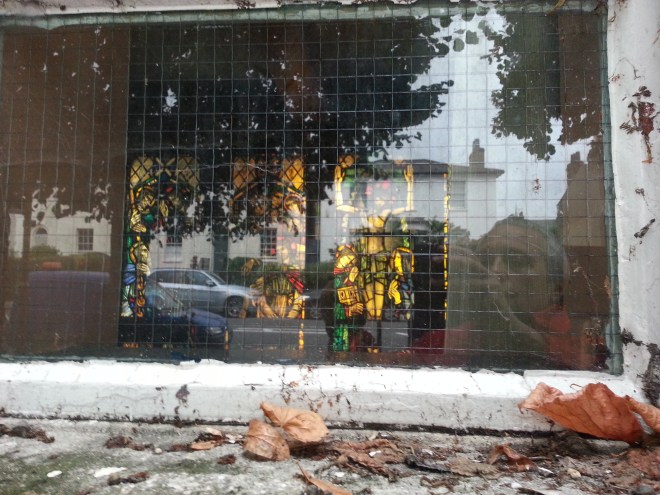
St Mark's Church window

Our father

Who is neither in heaven nor anywhere else

Thus it’s worthless to hallow your name.

I rather if your Kingdom never comes

Your Will is the big unknown to us.

We have to work for our daily bread

(you could give us something else instead).

You can forgive our trespasses

But we can’t forgive your crimes

and the stupidity of our neighbours.

Please, lead us into temptation!

If you fancy

make a pact with the Devil.

You can keep the boring heaven

But it’s time you leave the Earth!

Let us play our games here without your intervention.

When have you last shown your good side?

On the Earth you seem to have strange favourites.

You make the ugliest rich

and many good people poor.

You throw illness and disability at people

as if their suffering fulfilled any purpose.

You create or unwilling to stop wars and destruction.

Jesus!

They claim

you sent your son down here

and allowed him to become the play-thing

of admirers

and murderers.

They claim

The Guilt

generated by his cruel murder on the cross

will make people better.

I have not seen any proof yet.

Power and Glory are made off melting materials.

You can keep them too, we need something else.

Amen